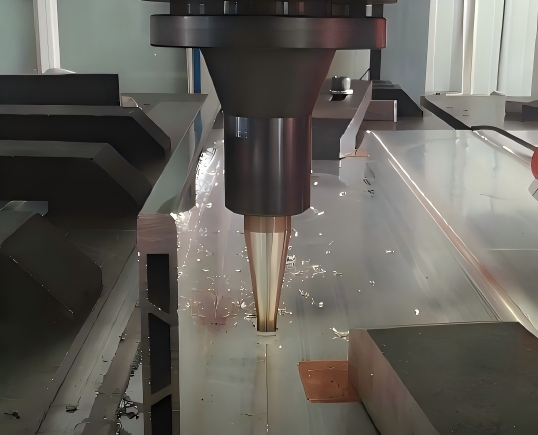
Friction Stir Welding (FSW) is a solid-state joining technology renowned for its unique advantages, including no molten pool, low distortion, and high joint strength. These characteristics have made it widely adopted in lightweight manufacturing industries such as aerospace, rail transportation, electric vehicles, and thermal management systems.
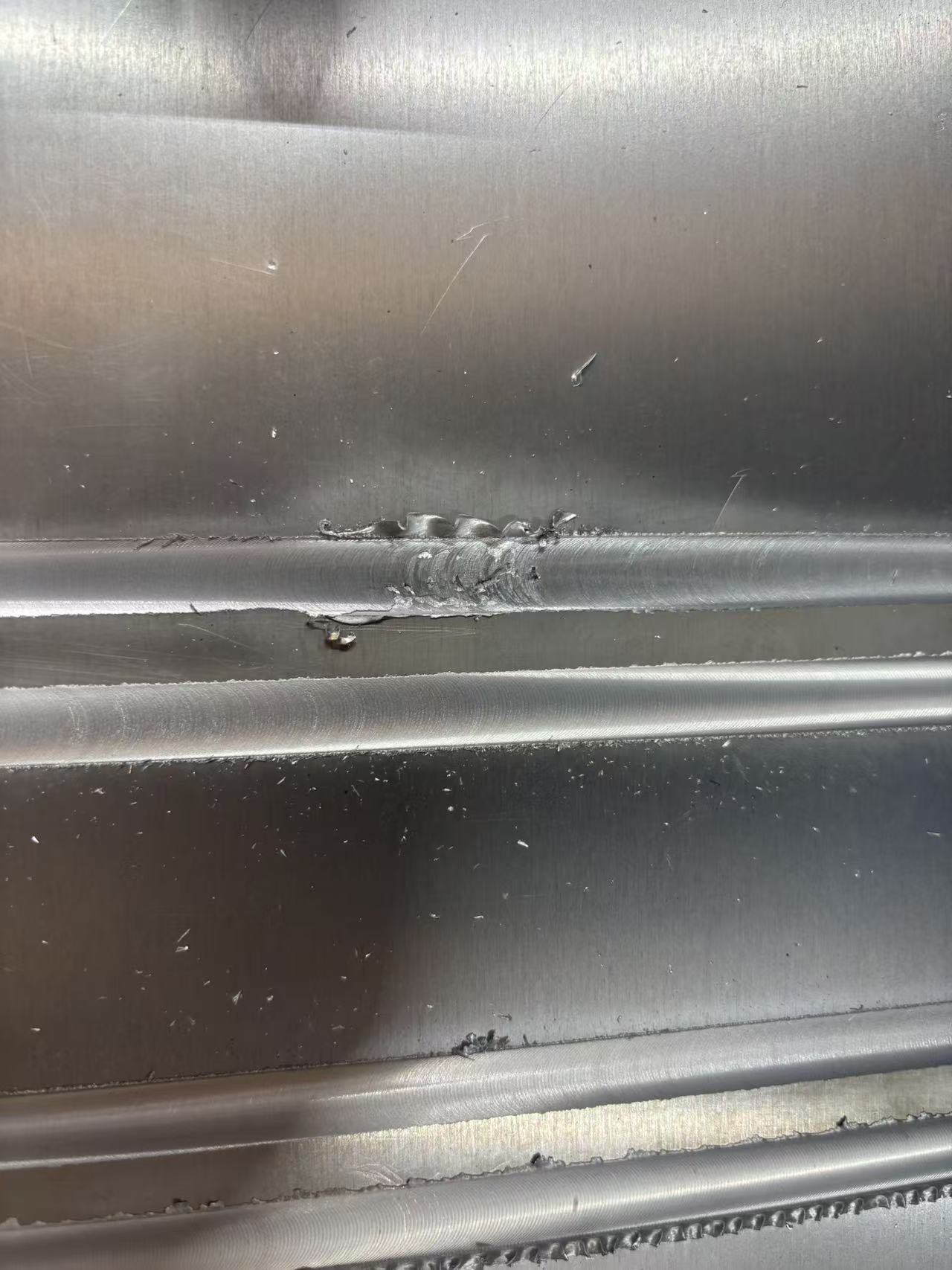
However, during practical production, voids and tunnel defects remain among the most common—and often overlooked—weld quality issues. These internal defects significantly reduce the mechanical strength and fatigue life of welded joints, and in severe cases, can lead to product rejection.
In most cases, these defects are not caused by machine failures or material quality, but rather by improper welding parameter combinations that disturb the balance between heat input, material flow, and forging pressure.
This article begins a series that systematically explores the formation mechanisms, influencing factors, and optimization strategies for void and tunnel defects. In this first installment, we focus on the most fundamental cause: improper welding process parameters.
1. The Primary Cause: Imbalance of Welding Process Parameters
The quality of an FSW joint is fundamentally determined by the interaction of three critical process parameters:
- Tool rotational speed
- Welding (travel) speed
- Plunge depth / forging force
When these parameters are properly matched, the base material is sufficiently plasticized, flows smoothly around the tool, and is fully consolidated into a dense, defect-free weld.
Conversely, an improper parameter combination leads to insufficient material flow and inadequate consolidation, eventually producing internal voids and tunnel defects.
2. Low Tool Rotational Speed: Insufficient Heat Input and Poor Plasticization
Tool rotation generates the frictional heat required for plasticizing the workpiece and provides the stirring action necessary for material flow. Therefore, rotational speed directly controls both the heat input and the intensity of material mixing.
When the rotational speed is too low, frictional heat generated between the tool shoulder, pin, and workpiece decreases significantly. As a result, the weld zone cannot reach the temperature required for sufficient plastic deformation.
Under these conditions:
- Material plasticity is greatly reduced.
- Material flow becomes sluggish.
- The tool cannot effectively transport plasticized material from the advancing side to the retreating side.
- Incomplete filling occurs behind the tool.
During cooling, these unfilled regions remain as discrete voids. If the material flow obstruction extends over a larger area, the individual voids connect together and eventually develop into continuous tunnel defects.
In short, low rotational speed creates a "low-temperature, weak-stirring" condition, which is one of the primary origins of both defect types.
3. Excessive Welding Speed: Material Flow Cannot Keep Up
Welding speed refers to the travel speed of the rotating tool and determines how long heat is applied to each unit length of the weld.
At a constant rotational speed, increasing welding speed shortens the heating time available for the material.
Although instantaneous heat generation may still be sufficient, the material no longer has adequate time to:
- become fully plasticized,
- flow around the tool,
- refill the cavity left behind the moving pin.
This mismatch creates a lag between tool movement and material flow.
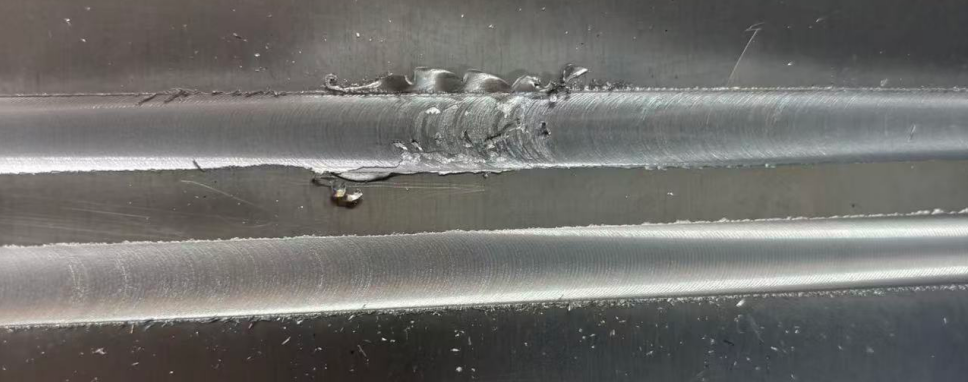
As the tool advances faster than the material can refill, continuous internal gaps remain inside the weld. These gaps eventually develop into continuous or semi-continuous tunnel defects, often accompanied by scattered small voids.
Industrial production experience consistently shows that excessive welding speed is one of the leading causes of tunnel defects, particularly in the lower region of the weld where the tool pin dominates material flow.
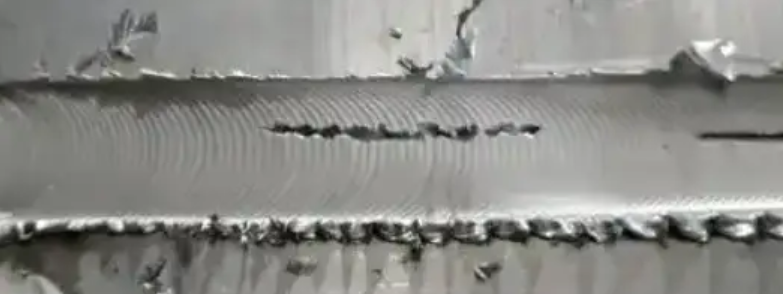
4. Improper Rotation Speed and Welding Speed Matching: Process Window Breakdown
Rotational speed and welding speed should never be considered independently.
Their relationship determines the heat input per unit length and the overall stability of material flow.
A commonly used evaluation index is the travel-speed-to-rotation-speed ratio. Every material, plate thickness, and product geometry has its own optimum processing window.
In real production, many defects result not from an individual parameter exceeding its limit, but from an improper combination of otherwise acceptable parameters.
For example:
- Low rotational speed combined with high welding speed results in insufficient heat input and inadequate material filling, dramatically increasing both defect frequency and defect size.
- Conversely, excessively high rotational speed combined with very slow welding speed produces excessive heat input. The material becomes over-softened, causing unstable flow, uneven material accumulation, and localized porosity.
Therefore, meeting the recommended value for a single parameter does not guarantee high weld quality.
Only by establishing a validated process window through experimental optimization can stable material flow be maintained and void or tunnel defects effectively prevented.
Simply copying process parameters from other products without considering material, thickness, and joint geometry is one of the most common reasons for mass production defects.
5. Insufficient Plunge Depth or Forging Force: Inadequate Weld Consolidation
One of the distinguishing characteristics of Friction Stir Welding is that it combines both material stirring and shoulder forging.
The plunge depth determines the axial forging force applied by the tool shoulder and is essential for consolidating plasticized material and eliminating microscopic internal gaps.
When the plunge depth or forging force is insufficient:
- The tool shoulder cannot adequately compress the softened material.
- Small cavities generated during stirring remain unclosed.
- Residual gaps between flowing materials cannot be consolidated.
Consequently, numerous microscopic voids remain inside the weld. These defects gradually merge into larger interconnected cavities, eventually forming visible tunnel defects.
Insufficient plunge depth also leads to poor surface appearance, uneven flash formation, and a loose internal microstructure.
Besides degrading weld appearance, these defects significantly reduce tensile strength and fatigue resistance, creating long-term reliability concerns.
It should also be noted that plunge depth must be optimized together with rotational speed and welding speed. Excessive plunge depth may cause excessive material thinning, while insufficient plunge depth directly compromises weld density.
Conclusion
From a process perspective, the formation of voids and tunnel defects in Friction Stir Welding can generally be traced back to three fundamental issues:
- Insufficient heat input, resulting in inadequate material plasticization;
- Unstable material flow, causing incomplete cavity filling;
- Insufficient forging pressure, preventing proper weld consolidation.
Specifically:
- Low rotational speed leads to poor plasticization.
- Excessive welding speed causes delayed material refill.
- Improper parameter matching disrupts the stable welding process.
- Insufficient plunge depth or forging force reduces weld density.
Understanding these mechanisms is the first step toward establishing a robust welding process window and consistently producing high-quality, defect-free FSW joints.
In the next article of this series, we will discuss how tool geometry, machine rigidity, fixturing, and backing support influence material flow and contribute to the formation of void and tunnel defects.